|
|
|
Nova Scotia Action Research Movement |
|
|
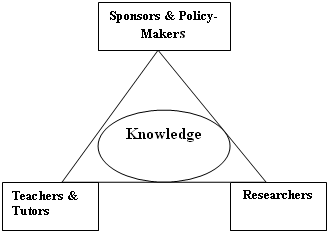
THE WORLD OF LITERACY EDUCATION IS SHAPED LIKE A TRIANGLE, BUT WE ARE STARTING TO CHANGE ITB. Allan Quigley, Some say the world is flat. Others insist it is round. But what I have learned working in the field of adult literacy and basic and education (ABLE) for almost 40 years is that our world is triangular. How is this possible? Since the late 1960's I have lived in what I would describe as a three-cornered world. The first corner was the world of teachers and tutors. As an ABE teacher in Northern Saskatchewan, then Alberta, and back to Saskatchewan again, I was a practitioner sharing common aspirations for our learners and our program. I lived in the culture of that teaching world and learned it is very different from that of government, where I worked for the second decade of my life in literacy. As a civil servant responsible for the GED, for ESL and ABE for Saskatchewan in the governmental corner of the triangle, I was then part of a different set of aspirations for the wider field. I came to know the culture of government well, and can attest to the fact that the teaching and civil servant nations may be in the same world triangle but they are typically very far apart. Now, for the past 19 years, I have been a member of the third corner of this literacy world of ours. I am part of a small group of academic researchers and (who often also teach) living in university settings, various research institute settings, and, in some cases, who are research consultants. We too have certain aspirations for the field, and most of us would agree we reflect a certain culture. Through the years I have lived the differences of the three cultures—differences that are deeply entrenched and not often discussed. But this short article is not about differences. Rather, I would like to think that there is a space that connects us all—a growing circle that we can all contribute to and learn from. Our world may be triangular, but it doesn't have to be that way forever. The area that gives me the most hope is that dedicated to knowledge. It touches learners, teachers, policy-makers and researches alike, and despite our differing views and intentions, we are all in the same literacy knowledge business. What we need is to learn how to work more closely together in knowledge despite the triangular distances that separates us. Not only for the learners whom serve, but for the growth, health and future of this fragile field.
SOME THINGS I'VE LEARNED ABOUT KNOWLEDGELooking back, I have spent a lot of time thinking about knowledge and the role knowledge should play in literacy. As a teacher in Northern Saskatchewan and then in Northern Alberta, I worried about what the content I should be teaching and how I should be teaching it. As a college director in Regina responsible for ABE and ESL, we were constantly asking what was needed, wanted, and required by our approximately 200 learners, our many sponsors, and the 35 teachers on staff. At that time, we taught a largely college-created, Ministry-approved, ABE curriculum with English, math, science and social studies. We even had had two shifts—an ABE day school and an ABE night school. We had a largely college-created curriculum on Life Skills, and another called Native Lifeskills taught at the city's Native Friendship Centre. We had another for the physically and mentally challenged called Independent Living for the Handicapped, and a wide range of ESL courses from "Lower Beginners" to "Upper Advanced." We were constantly providing knowledge to our learners, but we were also constantly seeking knowledge to help us become better teachers, tutors, and administrators. Like so many others, both then and now, I used trial and error both as a teacher and as an administrator. If I ever saw a research-based article on literacy it was not because I was reading the literature. Frankly, I didn't know what journals existed, nor did we subscribe to them in the programs I was part of. If anything, like so many around me in the teaching culture, we all were rather skeptical of the research literature. After all, we lived in the real world of literacy education. Academics who wrote such books and articles evidently lived in ivory towers and talked about irrelevant theory. During the second decade of my work in this field with the provincial government in Saskatchewan I administered the GED, and the province's ESL and ABE programs. Once again, what I learned came not from research but for others in similar roles. And, I hate to admit it, but the "best research" anyone found and passed around in the governmental offices I was part of typically were considered "good" only if they affirmed what we were already doing, or somehow verified what the policy-makers were planning to do. How did we attain knowledge? It was largely through trial and error, but now at taxpayers' expense. And so, to complete the triangle, in 1987 I attained a doctorate in adult education and entered the academic world that same year. I took with me the concerns that I had lived with for so long—concerns about student dropout, about recruitment challenges, about teaching issues, and about learner motivation and learning questions. Now, after almost twenty years researching such questions and publishing articles and books—always trying to contribute to the knowledge base in each of the three corners of literacy, I look around and what do I see? I see history repeating itself. I see teachers in one corner basing their decisions on what others in their programs have done and relying on trial and error to address basically the same questions I faced in the early 1970s. Talking with officials from various provincial and the federal government, I find the same (guarded) doubts, concerns, questions, and concerns I was part of in the 80s in government. I find sponsor-based programs are still rolled out on a hope and a political prayer with minimal front-end research. And, in the researchers' world, it is more than obvious that few of the research-based publications from our "ivory towers" reach the hands of teachers or tutors. Even when they do, it often seems that researchers do not have the appropriate answers for the pressing and immediate questions of practitioners or governments. After almost forty years, I have to ask: "Are we forever locked into this triangle of three solitudes?" If so, "How can we change and build this field together?" GETTING STRONGER IN THE CIRCLE OF SHARED KNOWLEDGEActually a lot has changed since I entered this field. Specifically, there is far greater promise today than ever with respect to knowledge. Since about the late 1980s, the world of research has opened up. Literacy and adult education has shifted away from an academic monopoly on knowledge production. The assumption that only professors can "do research" has been undone. Today, there is a new term gaining wide acceptance in the field of adult education—"practitioner-researcher." This refers to the hundreds of teaches, tutors and administrators conducting systematic research in their own work place. The K-12 school system has been engaged with variations of research-in-practice for decades but, today, ABLE teachers are conducting their own research in Australia, the USA, the UK and across Canada. In most cases, these initiatives are being financially and professionally supported by federal, provincial, territorial and state governments. In some cases, they are being supported by university academics and the research community. In Canada, the National Literacy Secretariat has been firmly behind Research-in-Practice and the new Adult Learning Knowledge Centre at the University of New Brunswick has recently helped fund various initiatives, including one here in Nova Scotia. But in all cases, the space for knowledge has expanded. We are getting stronger in the area of knowledge every day in literacy. FROM KNOWLEDGE FOR THE FEW, TO EMPOWERMENT FOR THE MANYWhat does the future hold? According to G.J. Whitehurst with the U.S. Department of Education's' Institute for Education Sciences, the field of adult literacy should be building into the 21st century through evidence-based research. Evidence-based education, he says, is: "The integration of professional wisdom with the best available empirical evidence in making decisions about how to deliver instruction" (cited in Comings, 2003, p. 2). In Canada, this is happening today through practice-based research in British Columbia, Alberta, in Saskatchewan, in Manitoba, in Ontario and, as of March 24, 2006, we can add Nova Scotia to this list (see the listed Websites at http://www.ns.literacy.ca/nsarmove/links.htm). In March, a group of some 50 ABLE practitioners gathered at Debert, NS for a workshop. Following a day and a half of fun and hard work, the Nova Scotia Action Research Movement ("NS-ARM") was launched. Nine separate action research projects designed by the teachers, tutors and administrators who came together were put into motion. Several of these studies will focus on student dropout issues, some are focusing on recruitment, others on participation. In all cases, real questions arising from everyday issues are being addressed through systematic action research. The data collection techniques are as rigorous as in any university or institute setting, and the results are already being shared on the new NS-ARM section of the LNS website (http://www.ns.literacy.ca/nsarmove). Today, practitioners, policy-makers and researchers can search multiple Websites for findings on common literacy problems (http://www.ns.literacy.ca/nsarmove/links.htm). We can communicate with the practitioner-researchers through e-mail, we can raise new issues and questions in this NS-ARM Webspace and, for the first time in my literacy lifetime, we can truly learn from one another and lift this entire field. We no longer need to re-invent the literacy wheels on dropout, recruitment, teaching and a host of other common issues because certain forms of research have been endorsed by governmental sponsors around the world as part of what any practitioners can do. We have a growing circle of capacity and knowledge that we can all contribute to and share that is changing this field. But, in closing, I have to say I do have one regret. I wonder if I entered the field forty years too soon? Were I to have entered today, I would hope to see this triangular world of ours begin to evolve towards a circle of learning. Towards a field of adult basic learning rather than one of adult basic education. Still, if the enthusiasm we saw in Debert holds its momentum, it may come to pass in my lifetime that the triangle of cultures and differences and separate agendas will become a circle of dialogue and mutual discovery. One can always hope that knowledge will not always give power to the few, but will one day empower us all. SOURCESComings, J.P. (2003, September). Establishing an evidence-based adult education system. NCSALL Occasional Paper. National Center for the Study of Adult Learning and Literacy, Harvard Graduate School of Education: Harvard University, Cambridge, MA. Allan Quigley is a Professor of Adult Education at St. Francis Xavier University. His main research interest is adult literacy and he has an upcoming book, Building Professional Pride in Literacy which should be out in early fall, 2006 from Krieger Press. |
|
|